




Low Levels of Drugs Found in Drinking Water
March 11, 2008 — Tiny amounts of pharmaceuticals -- including antibiotics, hormones, mood stabilizers, and other drugs -- are in our drinking water supplies, according to a media report.
In an investigation by the Associated Press, drinking water supplies in 24 major metropolitan areas were found to include drugs.
According to the investigation, the drugs get into the drinking water supply through several routes: some people flush unneeded medication down toilets; other medicine gets into the water supply after people take medication, absorb some, and pass the rest out in urine or feces. Some pharmaceuticals remain even after wastewater treatments and cleansing by water treatment plants, the investigation showed.
Although levels are low -- reportedly measured in parts per billion or trillion -- and utility companies contend the water is safe, experts from private organizations and the government say they can't say for sure whether the levels of drugs in drinking water are low enough to discount harmful health effects.
Low levels of pharmaceuticals in the water supply have been a concern for a decade or longer. The finding of pharmaceuticals in public water supplies is not a new phenomenon.
According to a science fellow at the Natural Resources Defense Council, an environmental action group, "Ever since the late 1990s, the science community has recognized that pharmaceuticals, especially oral contraceptives, are found in sewage water and are potentially contaminating drinking water."
Concern among scientists increased when fish in the Potomac River and elsewhere were found to have both male and female characteristics when exposed to estrogen-like substances, she says. For instance, some fish had both testes and an ovary. Scientists started looking at the effects of oral contraceptives first. "Now analyses have expanded to look at other drugs."
Technology has made this research easier, says Suzanne Rudzinski, deputy director for science and technology in the Office of Water at the U.S. Environmental Protection Agency. "Analytical methods have gotten better and we are able to detect lower levels than ever before."
All sides of the debate agree this is not known for sure. "At this point, we don't have evidence of a health effect," Rudzinski says, "although it's an area of concern and one we will continue to look at."
It's true that the levels of the medications found in drinking water] are very low. But especially when it comes to pharmaceuticals that are synthetic hormones, there is a concern, because hormones work at very low concentrations in the human body. We think this report, in particular, is a call for our federal agencies -- EPA in particular -- to do further studies to see what the health effects are.
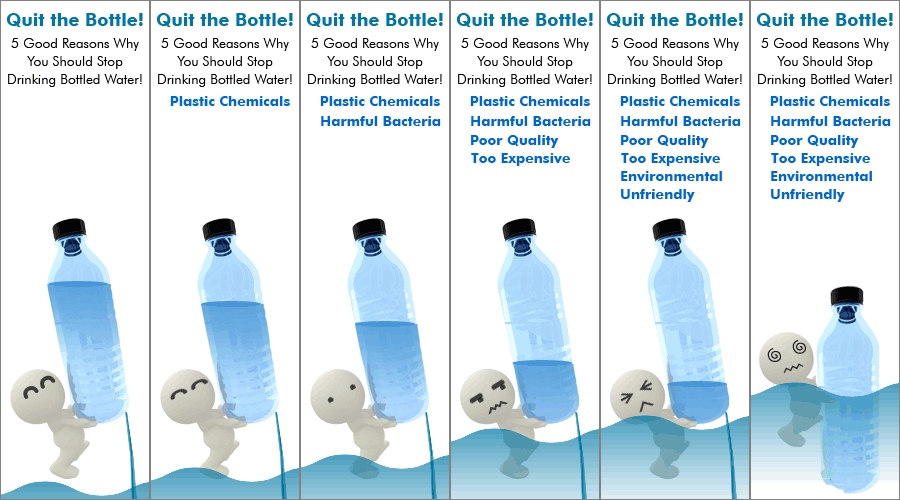
According to the Natural Resources Defense Council, boiling will not solve the problem. And forget bottled water as a way to escape the low levels of drugs found in some public water supplies. "Twenty-five percent of bottled water comes from the tap," she says, citing an NRDC report.

Labels on bottled water, regulated by the FDA, help consumers know what they are getting, says Stephen Kay, a spokesman for the International Bottled Water Association. If bottled water companies use water from municipal sources and do not treat it further to purify it, the FDA views the source as legitimate but requires the label to state that it is from a municipal or community water system. Bottled water companies that use municipal source water, but then treat and purify it by using reverse osmosis, distillation, or other processes can label it as such using terms such as "purified water" or "reverse osmosis" water.
Home filtering systems such as reverse osmosis may reduce the medication levels, says Timothy Bartrand, Ph.D., a postdoctoral fellow at Drexel University, Philadelphia, who participated in a National Science Foundation workshop to develop a drinking water research agenda. " An activated charcoal system will remove some pharmaceutical drugs but not all," Janssen says. "A reverse osmosis system can also remove some."
Contact your local public utilities and ask them what pollutants they test for in drinking water, Janssen says, as one way to raise awareness of the problem. When disposing of expired or unneeded medications, don't flush them, Rudzinski says. Instead, mix unused or unwanted drugs with coffee grounds or kitty litter, something that will be unpalatable to pets. Put the mixture in a sealed container so it's not accessible to children or pets and put the mixture in the trash.
Source: Kathleen Doheny. Healthy Information. March 11, 2008
